
Dialed GG Time
Loading game...
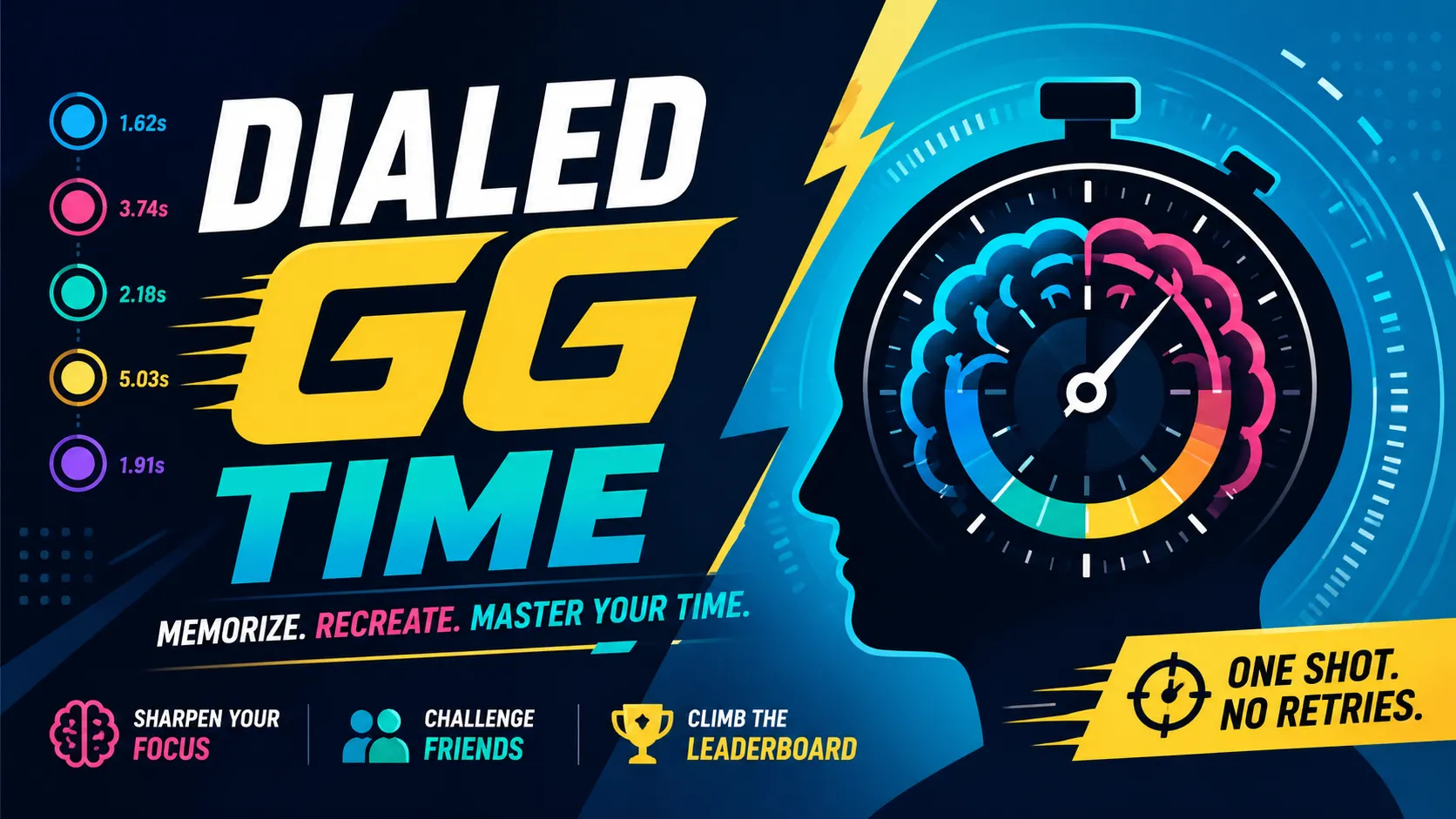
What is Dialed GG Time?
You think you know time. You feel it ticking away every second of your life. Dialed GG Time laughs at that confidence. The game flashes a series of precise durations—one by one—then vanishes them, forcing you to recreate each interval exactly by holding or tapping at the right moment. It's a brutal test of your brain's internal stopwatch.
What makes it addictive (and humbling) is how deceptively simple it sounds. A short pulse, a longer one, random gaps between 1-10 seconds or so. But your memory warps them instantly. Most players are shocked at how far off their guesses land. Perfect for daily brain training, rivaling friends, or proving you're the master of your own timeline.
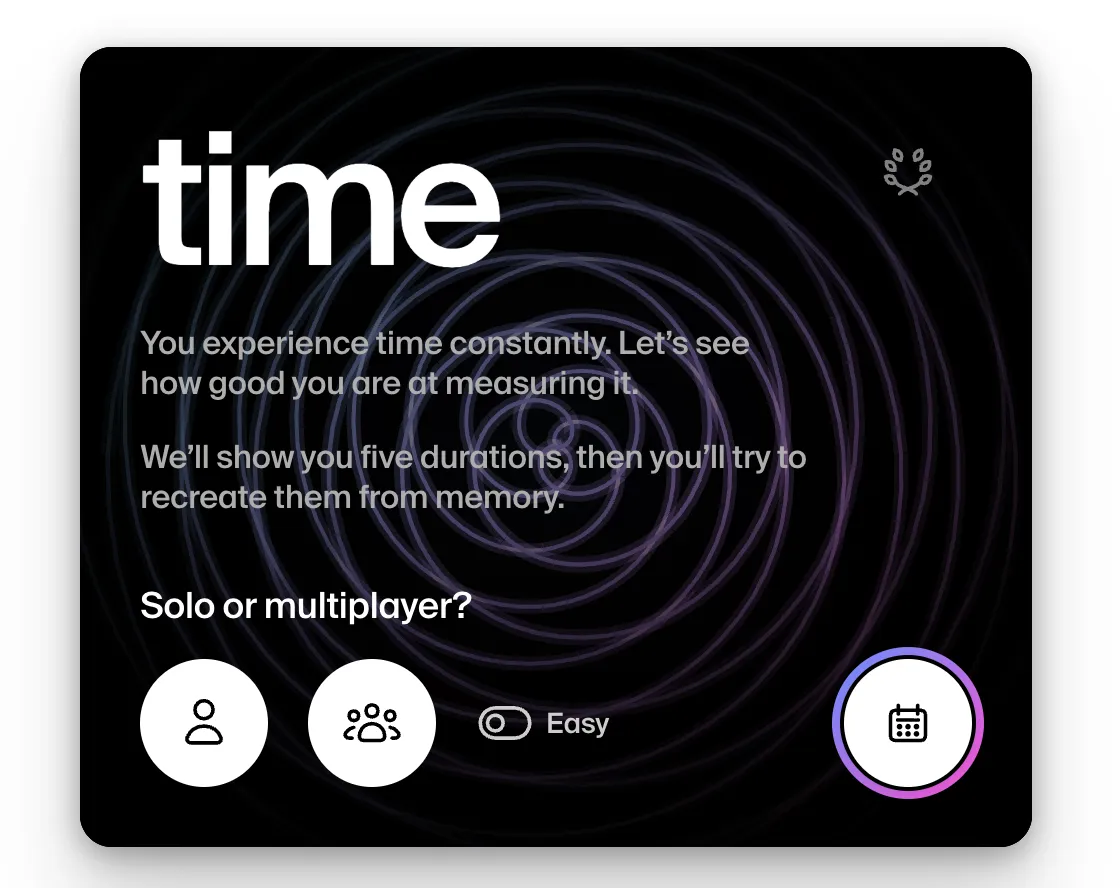
Dialed GG Time Game Rules (The Catch / The Trap)
Five isolated time pulses. No visuals to cheat with—just pure duration memory.
- Listen & Memorize: A bar or indicator pulses for an exact random duration (easy/hard ranges vary). You get a few seconds to lock it into your short-term memory.
- Recreate: After silence, you hold a button, tap, or drag to replicate that exact length. Release to commit.
- Scoring: Each round scores 0-10 based on how close your recreation matches the original (perceptual timing model). Total: 0-50. Closer = higher score.
- LOCKED IN: One shot per duration—no re-tries mid-round. The daily uses the exact same set for everyone.
- Modes: Easy, Hard, and Daily challenge. Multiplayer challenges let you compete on identical times.
Your internal clock is constantly lying to you. This game proves it.
How To Play Dialed GG Time?
Step 1: Start a round
The screen cues up. A visual pulse or tone marks the start. You watch/listen as the duration plays out (e.g., a steady fill or beat for ~3.7 seconds).
What you learn: Burn the exact feel of that interval into memory.
Step 2: Silence & Recall
Everything stops. A countdown or blank screen tests you. Your brain starts guessing.
Player Action: Prepare to replicate.
Step 3: Recreate the Duration
Press and hold (or interact) to start your version of the pulse. Time it precisely, then release.
Game Response: It calculates the delta instantly.
Result Example: Target 4.2s → Your 4.8s = solid mid-score. Target 2.1s → Your 1.4s = ouch, big penalty.
Step 4: Next Pulse & Feedback
See your round score and visual comparison (overlay or difference meter). Move to the next of five.
What This Means: Patterns emerge—maybe you're consistently slow on longer ones.
Step 5: Final Score
Total out of 50. Share, challenge friends on the same times, or check the daily leaderboard.
Repeat daily for improvement—your timing gets sharper with practice.
Strategy & Tips
- Focus on the feel rather than counting in your head—counting often backfires.
- Practice short vs. long durations separately; humans compress longer intervals in memory.
- Play with headphones or in a quiet space to avoid external distractions warping your clock.
- Use challenges against friends for motivation—nothing beats seeing their times side-by-side.
- Track your easy vs. hard scores over time to measure real gains in temporal memory.