Perfect Pitch Test Inaccurate? Common Myths and Correct Testing Methods
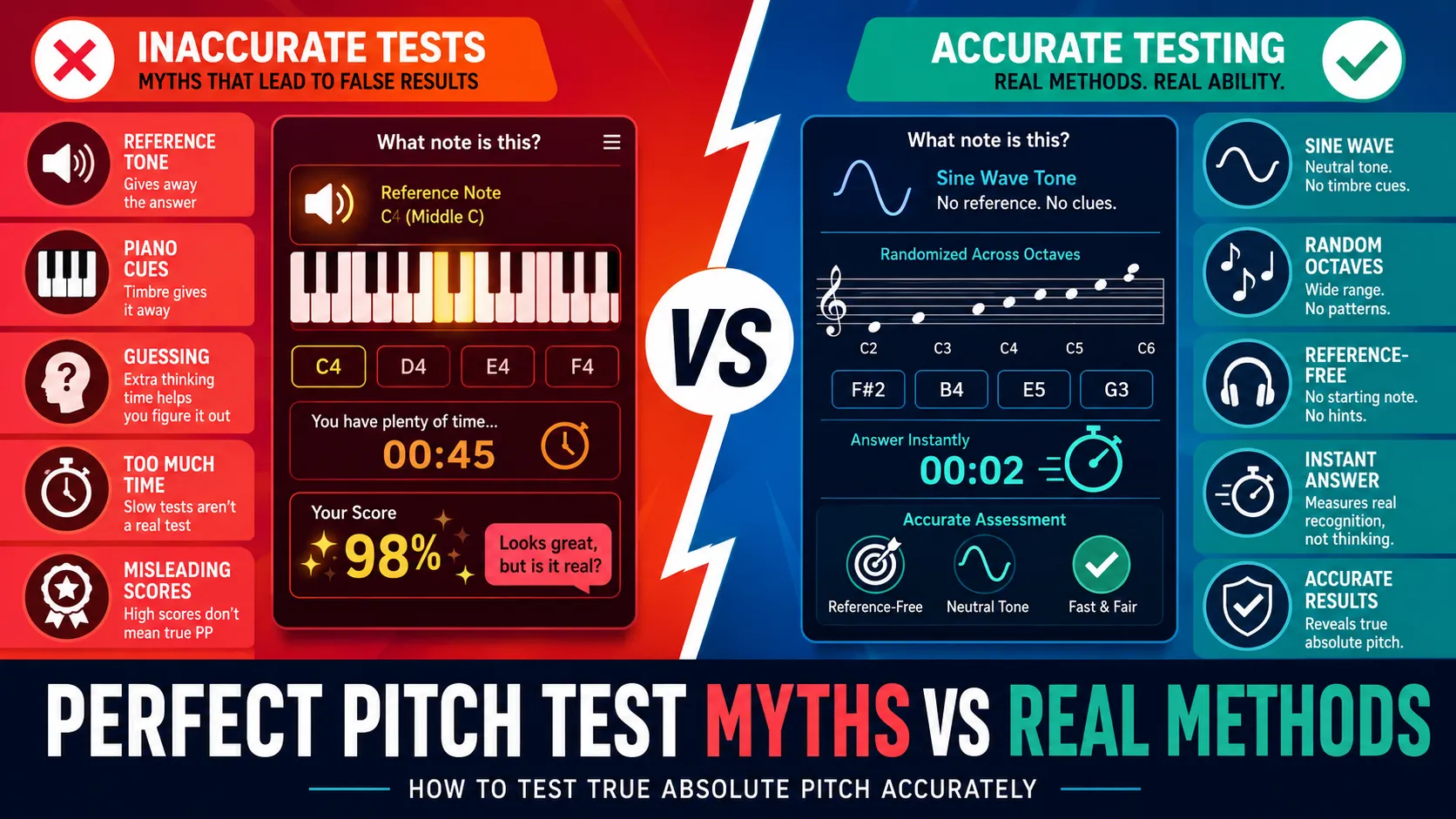
Most online Perfect Pitch tests feel "inaccurate" because they secretly allow relative pitch guessing, use piano sounds that give away the note, or start with a reference tone. Real absolute pitch testing must be reference-free, use neutral sine waves, randomize across octaves, and force instant answers.
Done correctly, the test reveals your true note-naming ability—no fluff, no false highs.
What Is It?
A Perfect Pitch (Absolute Pitch) test plays isolated musical notes and asks you to name them instantly (C, F♯, B♭, etc.) with zero help. True AP means 90%+ accuracy on random notes across several octaves, no context, no instrument nearby.
Most free tests online claim to measure this but use shortcuts that make results unreliable—especially for adults who rely more on relative pitch.
Common Myths That Make Tests Feel Wrong
-
Myth: High score = real perfect pitch
Many tests play a C first or let you compare to the previous note. That’s relative pitch in disguise, not AP. -
Myth: Piano or guitar sounds are fine
Each instrument has unique timbre cues (a piano C “sounds like C”). Switch to pure sine waves and most scores drop 30–50%. -
Myth: Testing only middle octave or white keys is enough
Real AP covers all 12 pitches in 3–4 octaves. Limited ranges let you guess by feel or memory. -
Myth: Thinking time doesn’t matter
If you get 5+ seconds, relative pitch or humming kicks in and inflates your result. -
Myth: One test session is reliable
Fatigue, room acoustics, or luck can swing scores wildly. Proper testing requires multiple sessions.
Correct Testing Method (Step-by-Step)
Use this exact protocol for accurate results:
-
Choose the right tool — Pick an app or site that offers pure sine-wave tones, full chromatic scale, and random octave selection. Avoid anything with “starting note” or piano sounds.
-
Setup — Quiet room, headphones, no instrument visible. Turn off any visual keyboard during playback.
-
Test rules — 50–100 random notes. Name each note immediately (under 3–4 seconds). No humming, no references.
-
Score properly — Count only exact note names (octave doesn’t matter for basic AP). Repeat the test on 3 different days and average the scores.
-
Pro version — For serious testing, use software that logs response time and consistency across sessions.
Follow these steps and your results will finally match reality.
Tips for Reliable Results
-
Test RP first — Do a quick interval or scale-degree quiz. Strong relative pitch often masquerades as AP.
-
Use sine waves only — If your current test uses piano, switch immediately—your score will be more honest.
-
Limit session length — Stop after 20–30 notes to avoid fatigue skewing results.
-
Track over time — Retest every month. Real AP stays stable; trained pitch memory improves gradually.
-
Don’t chase 100% — Even professional musicians rarely hit perfect on every note in a blind, multi-octave test. 70–80% with no references is already excellent.
Final Take
If your Perfect Pitch test felt inaccurate, it’s almost always the test design—not your ears. Skip the flashy online quizzes that sneak in references or piano tones. Use the strict, sine-wave, reference-free method above and you’ll get a real picture of your absolute pitch ability.
Most musicians thrive with strong relative pitch anyway. Test smart, train consistently, and focus on what actually helps you play music better.
Continue Reading
More guides, comparisons, and explainers related to the same games and topics.
Related Games
Browse games connected to the ideas, mechanics, or categories covered in this article.